
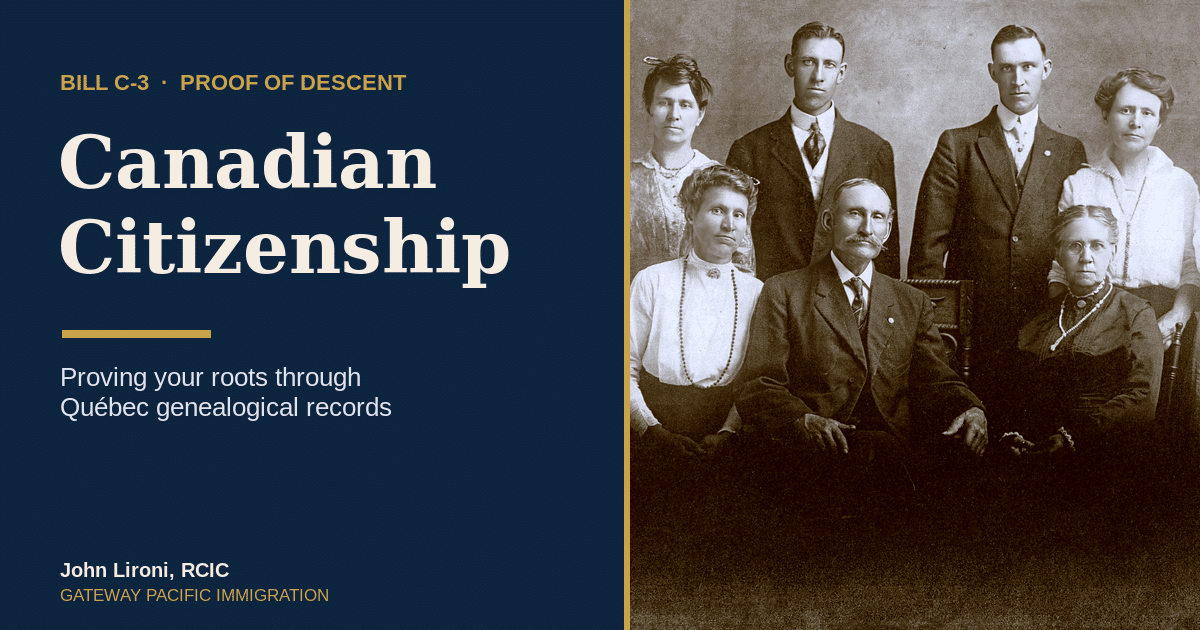
If you’ve heard that you might already have Canadian citizenship and didn’t know it, you’re not imagining things. With Bill C-3 now in force, a large group of people descended from Canadians can apply for proof of citizenship — and many of them have roots that run straight through Quebec.
The good news for that group is significant. Quebec is one of the best-documented populations in North America, with parish and civil records stretching back four centuries. The catch is that eligibility and proof are two separate problems, and most applications stall on the second one.
What Bill C-3 actually changed
Bill C-3 amended the Citizenship Act to remove the first-generation limit on citizenship by descent. It received Royal Assent on November 20, 2025, and came into force on December 15, 2025. Immigration, Refugees and Citizenship Canada (IRCC) estimates that somewhere between 350,000 and 500,000 people may be affected.
In plain terms: Canadian citizenship by descent can now pass beyond the first generation born outside Canada, provided the new rules are met. For people born before December 15, 2025, the law recognizes citizenship retroactively in the second and subsequent generations born abroad. For those born on or after that date, the Canadian parent must meet a physical-presence requirement of 1,095 days in Canada.
If you descend from a Canadian — including the many families who left Quebec for the United States in the late 1800s and early 1900s — this may open a door that was closed before.
Why proof, not eligibility, is the hard part
In 20 years of practice, the pattern is consistent. Confirming that your ancestor had Canadian citizenship is usually the easy step. The difficult task is documenting the unbroken chain of births and marriages that links that ancestor to you, one generation at a time.
A certificate of Canadian citizenship isn’t granted on a family story. IRCC needs primary records — birth, marriage, and sometimes death documents — for every link in the chain. A single missing baptism record or marriage certificate three generations back can hold up an otherwise strong application.
That’s why the work starts in the archives, long before the application is filed.
The Quebec archives worth knowing
If your line passes through Quebec, you have an advantage few applicants enjoy. Here are the records that matter most, and where to find them.
Bibliothèque et Archives nationales du Québec (BAnQ)
BAnQ is the province’s central archive and the natural starting point. It holds parish registers, civil status records, and notarial documents — including marriage contracts, which often confirm relationships that vital records alone don’t capture. Much of the collection is digitized and searchable online.
The Drouin Collection
The Drouin Collection is the backbone of French-Canadian genealogy: Catholic baptism, marriage, and burial records covering roughly three centuries. Because the Catholic Church in Quebec recorded these events meticulously, the collection is unusually complete. It’s searchable through Genealogy Quebec (Généalogie Québec).
PRDH (Programme de recherche en démographie historique)
Run by the Université de Montréal, the PRDH is an indexed database of vital events for the early French-Canadian population, covering roughly 1621 to 1849. If your line reaches back to the colonial period, the PRDH can connect generations that are hard to trace anywhere else.
Library and Archives Canada (LAC)
LAC holds the federal records that round out a Quebec file: census returns, immigration records, and naturalization files. Census records in particular are useful for placing a family in a specific household at a specific time, which helps bridge gaps between vital records.
Directeur de l’état civil du Québec
For events in the modern era — generally the 20th century onward — civil records are held by the Directeur de l’état civil. This is where you’ll request official copies of more recent births, marriages, and deaths needed to complete the chain.
A practical order of operations
Work backward, not forward. Start with what you can prove about yourself and your parents, then move one generation at a time toward your Canadian ancestor. For each link, secure a primary record before assuming the connection holds. When a vital record is missing, a marriage contract, census entry, or church record can often fill the gap.
Assemble the full documentary chain before you file — not after a request letter arrives. That single habit is the difference between a clean application and months of back-and-forth with IRCC.
Where to start
If you suspect a Quebec line in your family and you’re considering an application for proof of Canadian citizenship, the most valuable thing you can do early is map out the generations and identify exactly which records you’ll need. Get that right, and the rest of the process is far smoother.
This is general information, not legal advice. Every case is different — book a consultation for guidance specific to your situation and what to do to obtain proof of Canadian citizenship.
If a Quebec line is part of your family story, I’m glad to help you find your footing. Book a consultation and we’ll map out your chain together.
— John Lironi, RCIC | Gateway Pacific Immigration